
There was a time when the Zegama-Aizkorri was just a local race. A challenge set amid mud, fog, and pastures in the heart of the Basque Country. A course born from the mountains and those who lived there. No spotlights. No broadcasts. None of the pressure from millions of outside eyes.
Twenty-five years later, this Gipuzkoa-based event has kept much of that original spirit. That is likely the secret behind its legend. As trail running grew into a global industry, Zegama never stopped being a race organized by and for mountain lovers.
Sure, now there is an avalanche of applications for just a few race numbers. Today, the best runners on the planet line up on its trails. The race racks up millions of digital impressions and holds a prime spot on the international calendar. But when the clock strikes nine in the morning and the pack leaves the village streets, everything remains exactly the same: the enthusiasm of the people.
**A race born from a way of understanding the mountain**
Zegama’s story cannot be understood purely through sports. Its roots are deeply tied to the land, Basque mountain culture, and the desire to bring life to the Aizkorri-Aratz Natural Park. The race emerged at a time when trail running was a niche pastime for a small group of athletes. Mountain races were homemade events, born from local clubs. Everything was still an emerging industry.
That first edition barely gathered a few hundred runners on a tough course with several technical sections, heavily influenced by the weather. Over the years, the mud, the slopes, and the rain gave it a unique character. It was not a fast race. Not a comfortable one. Not even visually spectacular. But it was wild. And that is precisely why it began to win over those seeking an authentic experience.
As time passed, Zegama matured without realizing it. It became the Holy Grail for national runners, and soon after, an object of desire for athletes worldwide. The arrival of major international figures multiplied its mystique, but also contributed to something much more important: building a collective narrative around the race.
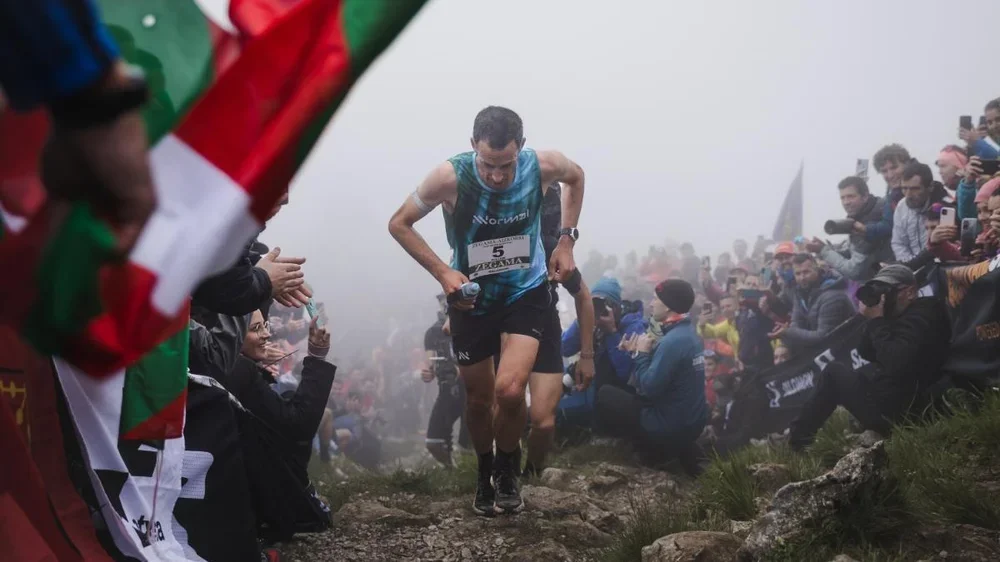
Because Zegama has never been just a course. It is the sound of cowbells. That famous human corridor on the climb to Sancti Spiritu. Mud up to the knees. The unique feeling of running through a natural stadium in the middle of the mountain. It is Basque sporting culture.
**When Zegama became immortal**
For years, images of the climb to Sancti Spiritu traveled around the world. Thousands of fans packed the mountainside, forming that iconic corridor to protect the runners, turning the race into an emblem. A sort of Tour de France of mountain running. An experience where the crowd is not just a complement, but an essential part of the show.
That is also where the legacy of some of modern trail running’s greatest legends began. Kilian Jornet’s titles elevated the race’s prestige even further, making his relationship with Zegama one of the sport’s most emblematic stories. But the race has transcended even Kilian’s figure. On its trails, unforgettable pages have been written by Stian Angermund, Rémi Bonnet, Maite Maiora, Oihana Kortazar, and Sara Alonso.
Each edition added a new chapter to the legacy. Snow. Torrential rain. Impossible comebacks. Epic battles. Suffering turned into beauty.
And while trail running evolved toward faster, more commercial (“TV-friendly”) races, Zegama kept its principles. It never wanted to abandon its identity.
**The paradox of growth**