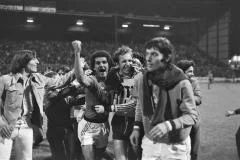

Patrick Revelli, the 74-year-old former AS Saint-Étienne striker who played for the club from 1968 to 1978 and still resides in the city, reflects on the socio-economic context of the era and its transformation, 50 years after the Greens’ Champions Cup final loss to Bayern Munich (0-1).
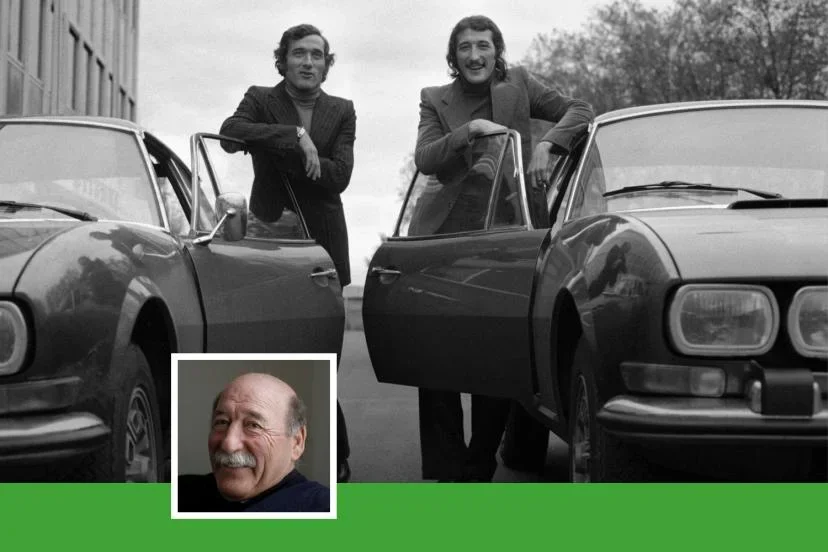
Recruited by Les Verts just after May 1968, Revelli, originally from Mimet in the Bouches-du-Rhône, returned to live in Saint-Étienne in 1985. The “Gaulois” – his playing nickname – loves his adopted city so much that he took on debt to lead the LREM list in the 2020 municipal elections (4.72% of the vote), not against his brother Hervé, a supporter of the outgoing LR mayor Gaël Perdriau, but to defend Saint-Étienne and his own ideas. Having paid off his loan, he remains as devoted as ever to his heart’s city, half a century after the final defeat.
“What image do you keep of your arrival in Saint-Étienne? Not the black city of the Greens that people talk about. Even though it was gray, I knew it as green and flourishing, rich with its inhabitants (223,223 in the 1968 census vs. 173,136 on July 1, 2026). I was 17 and not disoriented. I come from a family of Italian immigrants who came to work in the mines of Bouligny in the Meuse. My mother had a heart condition, and the doctor advised her to leave eastern France, too foggy and humid, for the air of the Midi. That’s why my brothers, including Hervé who is five years older, were born in Verdun, while I, the youngest, was born in Mimet, near the mines of Gardanne where my father, Roland, and Alain, the two eldest, worked alongside our brother-in-law Joseph and ‘Titou,’ the father of Bernard Pardo. His grandparents were my godparents. Growing up in the mining town of Les Moulières, arriving in Saint-Étienne was no shock. The only thing missing was the sun. That’s why I didn’t stay two years earlier – to see the sun again and my friends.”
Had you known the city before coming to play? “Yes. Since Hervé was starting his pro career and was single, Mr. Garonnaire (Pierre, a scout for AS Saint-Étienne) asked my parents to come live with him. My father was hired at President Rocher’s company, and I worked as an apprentice mechanic at Peugeot. When Hervé got married, I asked my parents to return to the Midi, where I played midfield for AS Gardannaise, where my father was always a true volunteer – still needed today. When he could afford a car, it was always full of players. Then Mr. Garonnaire brought me back to Saint-Étienne to sign an amateur license and gave me the No. 9 shirt – the same as Hervé’s. I was supposed to stay a year. I ended up playing ten years for Saint-Étienne, and I still live here, nearly sixty years later.”
Did the city’s values of sharing and hard work rub off on the 1976 Greens, or was it the other way around? “The club is more like the city, and that’s what shapes its identity. What’s the link between the Malian Salif Keita, the Dutchman Kees Rijvers, and the Franco-Algerian Rachid Mekloufi? The club. Given its working-class history, Saint-Étienne has always been a land of integration. Besides Osvaldo Piazza (Argentina) and Ivan Curkovic (ex-Yugoslavia), we all came from the training center. Who says training says ‘molded.’ The 76 Greens came from all over France, but we’re all from here. I became one of them and now I’m part of the scenery. I’m not alone. Many of us stayed in Saint-Étienne or the region. We had such a strong Stéphanois culture and mentality that it soaked into us, and we shared it every day – right from the start.”
“The training center didn’t exist; I moved into a large apartment with three other young players, including Jean-Michel Larqué, on Rue Brossard, near city hall. Christian Sarramagna, Jacques Santini, Alain Merchadier, and Christian Lopez lived a bit higher up on Rue Pierre Termier. We took the tram to Place Marengo – the old Stéphanois square, now called Jean-Jaurès – and got off at Rue Claude Odde to walk to Geoffroy-Guichard. We walked the five-kilometer return trip, unless a pro gave us a lift, to have lunch at the Gare de Châteaucreux with Mr. and Mrs. Guerrier. In the evening, we cooked for ourselves. ‘Pierrot’ (Pierre Repellini) brought us luxury when he arrived with his father’s car a year later. Considering where I come from, it was pure happiness.”
Did it stay that way after turning professional? “Yes. During the 1972-73 season, the Firminy slaughterhouse where my father-in-law worked as a tripe butcher with my brother-in-law (my wife’s brother) had a power cut. Since the meat was at risk of spoiling, I went to help them – scalding myself all morning to remove the hooves from pigs and sheep. It didn’t bother me. I was born and raised in solidarity. On the field, I thought it was natural to run after a ball lost by a teammate. The Greens were also a school of life, taught by the older players. If you were unlucky enough to enter the locker room without knocking, Georges Polny would order us: ‘Kids, get out!’ Georges Bereta warned us: ‘Cough before entering and when leaving the locker room. Inside, you’re never sick or injured.'”
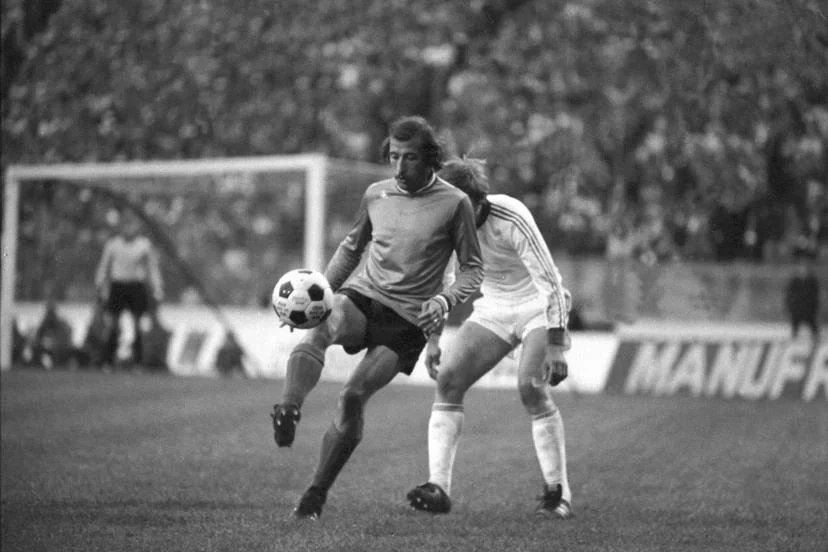
Did you ever imagine the city and the club would fall apart like this? “No. Because when the forges and steelworks, the Loire coal mines, and big companies like Cycles Mercier or Manufrance (1) started facing difficulties, Michel Durafour, the mayor, was Minister of Labor (1974-1976), then Minister Delegate for Economy, Finance, and Budget (1976-1977). So how could everything close down? I don’t understand. We got everything wrong, and the city lost 50,000 inhabitants. And whether you like it or not, everything revolves around the club. As they say: ‘When the Greens cough, the city is sick. When they’re doing well, Saint-Étienne smiles